
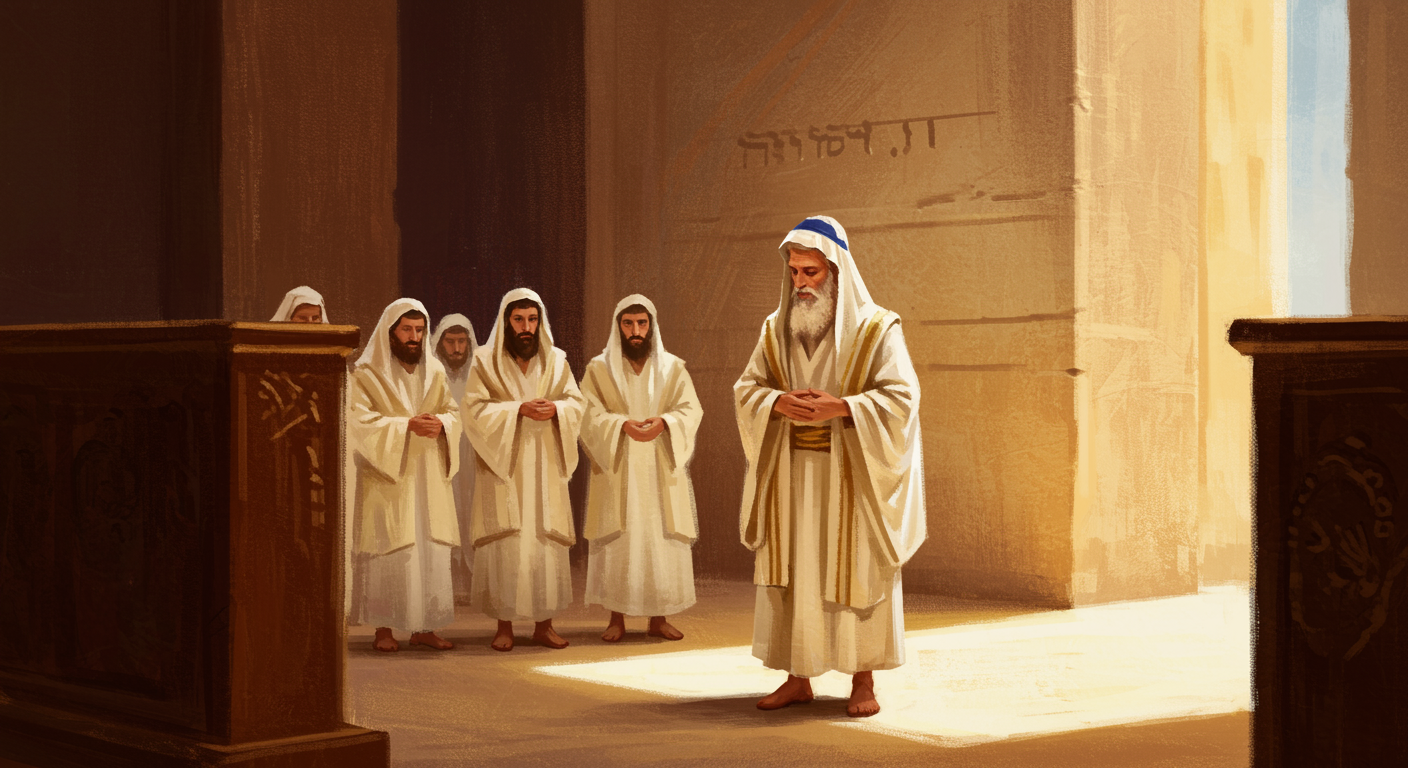
The Law of the Stranger: Blessing all the Families of the Earth

In recent years, much eisegesis has been done to make Scripture fit modern political motifs. In doing this, the ancient context is missed, and sometimes this actually blinds us to great truths. One issue in which this is done is immigration. Other verses are sometimes used, but Leviticus 19:33-34 seems to be the go-to verse to attempt to prove that the Bible abolishes national borders and that nations cannot regulate immigration. Recently, this has been used to argue that Immigration and Customs Enforcement (ICE) is inherently tyrannical and illegitimate by its very existence

James 1:14-15

“But each one is tempted when he is drawn away by his own desires and enticed. 15 Then, when desire has conceived, it gives birth to sin; and sin, when it is full-grown, brings forth death. ”

 Let’s unpack the context here:
The first context is that this was a provision of the Mosaic Covenant. The United States government and the governments of other Gentile nations are not subject to the Mosaic Covenant. This, then, is not legally binding on those governments. The Jerusalem Council determined that the Mosaic Covenant was not binding on Gentiles. The righteousness it describes is the only binding on the conscience. This operates at the level of the human heart and includes knowledge that such sins as murder, theft,  and adultery, are wrong. This was what Paul was referring to when he wrote…


Romans 2:14-16 NKJV

“… for when Gentiles, who do not have the law, by nature do the things in the law, these, although not having the law, are a law to themselves,  (15)  who show the work of the law written in their hearts, their conscience also bearing witness, and between themselves their thoughts accusing or else excusing them)  (16)  in the day when God will judge the secrets of men by Jesus Christ, according to my gospel..”

The Levitical law was fulfilled in Christ through His death on the cross. He sacrificed once for all, and there was no need for sacrifices. Hebrews shows the superiority of the Priesthood of Melchizedek over that of Aaron by showing that it was not dependent on a lineage, but an indestructible life. The Priesthood of Melchizedek is not dependent on the Mosaic Covenant but preexisted it.


Hebrews 7:1-28 NKJV

  For this Melchizedek, king of Salem, priest of the Most High God, who met Abraham returning from the slaughter of the kings and blessed him,  (2)  to whom also Abraham gave a tenth part of all, first being translated “king of righteousness,” and then also king of Salem, meaning “king of peace,”  (3)  without father, without mother, without genealogy, having neither beginning of days nor end of life, but made like the Son of God, remains a priest continually.  (4)  Now consider how great this man was, to whom even the patriarch Abraham gave a tenth of the spoils…  …(12)  For the priesthood being changed, of necessity there is also a change of the law.  (13)  For He of whom these things are spoken belongs to another tribe, from which no man has officiated at the altar.  (14)  For it is evident that our Lord arose from Judah, of which tribe Moses spoke nothing concerning priesthood.  (15)  And it is yet far more evident if, in the likeness of Melchizedek, there arises another priest  (16)  who has come, not according to the law of a fleshly commandment, but according to the power of an endless life.  (17)  For He testifies: “YOU ARE A PRIEST FOREVER ACCORDING TO THE ORDER OF MELCHIZEDEK.”  (18)  For on the one hand there is an annulling of the former commandment because of its weakness and unprofitableness,  (19)  for the law made nothing perfect; on the other hand, there is the bringing in of a better hope, through which we draw near to God.  (20)  And inasmuch as He was not made priest without an oath  (21)  (for they have become priests without an oath, but He with an oath by Him who said to Him: “THE LORD HAS SWORN AND WILL NOT RELENT, ‘YOU ARE A PRIEST FOREVER ACCORDING TO THE ORDER OF MELCHIZEDEK’ “),  (22)  by so much more Jesus has become a surety of a better covenant.  (23)  Also there were many priests, because they were prevented by death from continuing.  (24)  But He, because He continues forever, has an unchangeable priesthood.  (25)  Therefore He is also able to save to the uttermost those who come to God through Him, since He always lives to make intercession for them.  (26)  For such a High Priest was fitting for us, who is holy, harmless, undefiled, separate from sinners, and has become higher than the heavens;  (27)  who does not need daily, as those high priests, to offer up sacrifices, first for His own sins and then for the people’s, for this He did once for all when He offered up Himself.  (28)  For the law appoints as high priests men who have weakness, but the word of the oath, which came after the law, appoints the Son who has been perfected forever.

The civil law of the Mosaic Covenant is tethered to the legal force of the covenant. The United States government is not a signatory to the Mosaic Covenant, but has its own Covenant with God as a Gentile nation that once trusted in Him. Leviticus 19:33-34 is, therefore, not part of the United States Code or the United States Constitution.It can provide wisdom for us, but is not legally binding. What wisdom is it providing?


At the outset, it should be noted that Leviticus does not address modern immigration and was never understood as such by the Jewish listeners and readers. The border abolitionist crowd does eisegesis here. What was the Hebrew understanding of this?


Stranger is a Proselyte or Convert

When we compare all uses of the Hebrew word for stranger ( about 83), it is clear that the stranger is required to participate in the Mosaic Covenant.  This is roughly analogous to assimilation. Strangers who refused to be subject to the Mosaic Covenant were to be treated as idolaters and banished or put to death. Illegal aliens in the United States and other Gentile nations correspond more closely to idolaters than to strangers.


Stranger’s Obligation to the Mosaic Covenant
Establishes Them as Proselytes or Converts

Strangers required to keep the Passover
Exodus 12:18-19 NKJV In the first month, on the fourteenth day of the month at evening, you shall eat unleavened bread, until the twenty-first day of the month at evening.  (19)  For seven days no leaven shall be found in your houses, since whoever eats what is leavened, that same person shall be cut off from the congregation of Israel, whether he is a stranger or a native of the land.

Circumcised Strangers Legally the Same as Native born
Exodus 12:48-49 And when a stranger dwells with you and wants to keep the Passover to the LORD, let all his males be circumcised, and then let him come near and keep it; and he shall be as a native of the land. For no uncircumcised person shall eat it.  (49)  One law shall be for the native-born and for the stranger who dwells among you.”

Strangers required to keep the Sabbath
Exodus 20:10 but the seventh day is the Sabbath of the LORD your God. In it you shall do no work: you, nor your son, nor your daughter, nor your male servant, nor your female servant, nor your cattle, nor your stranger who is within your gates.

Strangers required to keep the Day of Atonement and included among the atoned ones
Leviticus 16:29-30 NKJV  “This shall be a statute forever for you: In the seventh month, on the tenth day of the month, you shall afflict your souls, and do no work at all, whether a native of your own country or a stranger who dwells among you.  (30)  For on that day the priest shall make atonement for you, to cleanse you, that you may be clean from all your sins before the LORD.

Is the stranger/ger/proselutos is required to observe the Passover, the Sabbath, the Day of Atonement, and be circumcised so that he might be eligible for the Passover, then he is converting to Judaism. It is noteworthy that the Hebrew ger is typically translated in the LXX as proselutos, meaning “proselyte.” Leviticus 16 translates it that way. We see with both the Passover and the Day of Atonement commands that the stranger was counted as a native Israelite. The stranger, under Mosaic Law, was a convert to Judaism.


This passage has zero application to illegal aliens or those who might nominally be legal but do not intend to assimilate, but rather more closely to idolaters, who sought to overthrow the worship of Yahweh God with idols and devils. Those who refuse to assimilate pose a cultural threat, as they can displace the original culture if they arrive in sufficient numbers. Arguments that nations cannot stop this are essentially arguments that a people should not exist.


The Law of the stranger is not a command for border abolition or cultural suicide through dilution, but an invitation for others to join your culture. There are three purposes behind the Law of the Stranger:


The Purpose of the Law of the Stranger

The first purpose of Leviticus 19:33-34 is to remind the Israelites that they were strangers in Egypt, and to treat strangers in their land the way they would want to be treated. It is the application of the Golden Rule to foreigners (Matthew 7:12). The second purpose is to formulate a consistent rule of law rather than a multi-tiered system or anything that could devolve into apartheid. The third purpose, and the most important, is that this allowed a pathway for foreigners to participate in the covenants of the people of God (Eph 2:11-22).


This third purpose was looking forward to the New Covenant, where Gentiles who converted to faith in the Jewish Messiah would be grafted into the family of God.  Ephesians 2:12-20 begins by instructing us that Gentiles were outside the covenants, but that Christ’s death created One New Man out of the Two.


Ephesians 2:11-22 NKJV

 Therefore remember that you, once Gentiles in the flesh—who are called Uncircumcision by what is called the Circumcision made in the flesh by hands—  (12)  that at that time you were without Christ, being aliens from the commonwealth of Israel and strangers from the covenants of promise, having no hope and without God in the world.

(13)  But now in Christ Jesus you who once were far off have been brought near by the blood of Christ.  (14)  For He Himself is our peace, who has made both one, and has broken down the middle wall of separation,  (15)  having abolished in His flesh the enmity, that is, the law of commandments contained in ordinances, so as to create in Himself one new man from the two, thus making peace,  (16)  and that He might reconcile them both to God in one body through the cross, thereby putting to death the enmity.

(17)  And He came and preached peace to you who were afar off and to those who were near.  (18)  For through Him we both have access by one Spirit to the Father.  (19)  Now, therefore, you are no longer strangers and foreigners, but fellow citizens with the saints and members of the household of God,  (20)  having been built on the foundation of the apostles and prophets, Jesus Christ Himself being the chief cornerstone,  (21)  in whom the whole building, being fitted together, grows into a holy temple in the Lord,  (22)  in whom you also are being built together for a dwelling place of God in the Spirit.


Covenantalists often misinterpret this when they say that Israel is simply Jews and Gentiles together as believers in the Church. This is partially true, as the people of God now have both Jews and Gentiles, but it is framed in a way that excludes Israel and constructs this as a Church-centric phenomenon. This text, however, presents it as Israel-centric. Instead of Israel being part of the church, the Church is actually part of Israel. Christ’s death makes it possible for Gentiles to be included under the rubric of Israel. What Christ’s death does in the New Covenant, the Law of the Stranger did within the context of the Mosaic Covenant by providing a path for Gentiles to become part of the Covenants. The systematic rejection of the Law of the Stranger by Ezra on behalf of a more ethnic identity for Israel paved the way for Jewish rejection of Christ later.


Romans 11 presents a picture of Gentiles being grafted into the Church. Israel was not cast away permanently, but for Gentiles to come into the vine of Israel under the New Covenant. Once the full number of Gentiles comes in, then Israel will be saved. Again, this is Israel-centric – accomplishing under the New Covenant what the Law of the Stranger did within the context of the Mosaic Covenant by providing a path for Gentiles to become part of the Covenants.


Romans 11:11-27 NKJV

  I say then, have they stumbled that they should fall? Certainly not! But through their fall, to provoke them to jealousy, salvation has come to the Gentiles.  (12)  Now if their fall is riches for the world, and their failure riches for the Gentiles, how much more their fullness!  (13)  For I speak to you Gentiles; inasmuch as I am an apostle to the Gentiles, I magnify my ministry,  (14)  if by any means I may provoke to jealousy those who are my flesh and save some of them.  (15)  For if their being cast away is the reconciling of the world, what will their acceptance be but life from the dead?  (16)  For if the firstfruit is holy, the lump is also holy; and if the root is holy, so are the branches.  (17)  And if some of the branches were broken off, and you, being a wild olive tree, were grafted in among them, and with them became a partaker of the root and fatness of the olive tree,  (18)  do not boast against the branches. But if you do boast, remember that you do not support the root, but the root supports you.  (19)  You will say then, “Branches were broken off that I might be grafted in.”  (20)  Well said. Because of unbelief they were broken off, and you stand by faith. Do not be haughty, but fear.  (21)  For if God did not spare the natural branches, He may not spare you either.  (22)  Therefore consider the goodness and severity of God: on those who fell, severity; but toward you, goodness, if you continue in His goodness. Otherwise you also will be cut off.  (23)  And they also, if they do not continue in unbelief, will be grafted in, for God is able to graft them in again.  (24)  For if you were cut out of the olive tree which is wild by nature, and were grafted contrary to nature into a cultivated olive tree, how much more will these, who are natural branches, be grafted into their own olive tree?  (25)  For I do not desire, brethren, that you should be ignorant of this mystery, lest you should be wise in your own opinion, that blindness in part has happened to Israel until the fullness of the Gentiles has come in.  (26)  And so all Israel will be saved, as it is written: “THE DELIVERER WILL COME OUT OF ZION, AND HE WILL TURN AWAY UNGODLINESS FROM JACOB;  (27)  FOR THIS IS MY COVENANT WITH THEM, WHEN I TAKE AWAY THEIR SINS.”

Conclusion

The Law of the Stranger does the opposite of what certain political commentators would have you believe. It doesn’t abolish borders and level culture, but preserves the territorial and cultural integrity while showing compassion. The Law of the Stranger looks forward to the New Testament, where Gentiles of all nations would become part of Israel, covered by the blood of Jesus. This was what God had in mind when He promised Abraham that ”  I will make you a great nation; I will bless you And make your name great; And you shall be a blessing.  (3)  I will bless those who bless you, And I will curse him who curses you; And in you all the families of the earth shall be blessed(Genesis 12:2-3 NKJV)”

Leave a Comment