
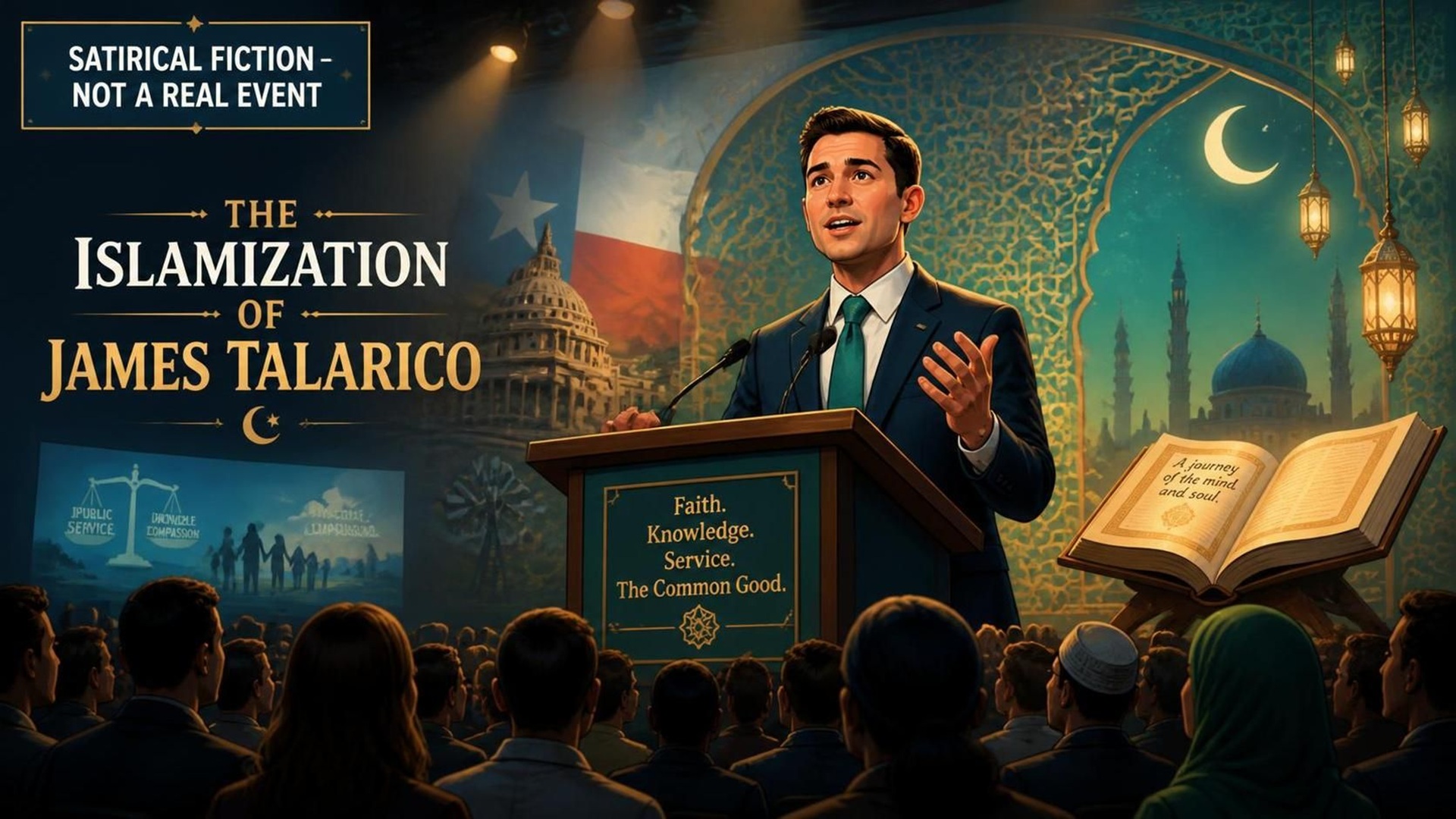
James Talarico is the Democratic nominee for a United States Senate seat in Texas. He identifies as a “Progressive Christian.” That identity is not particularly new on the Left. What is new is Talarico’s willingness to engage in apologetics and polemics to promote his religious brand and justify its use in politics. He is the opposite of a secularist within a party generally regarded as more secular-minded—though that may be changing as America itself becomes less secular.
Recently, Talarico made the following statement, which caught my attention. In fact, the statement is more compatible with Sufi Islam than with any traditional branch of Christianity:
“There are so many pathways to the sacred. The Islamic mystic Rumi said, ‘Every religion has love, but love has no religion.’ God is so much bigger than our human categories. God is not a Presbyterian. God is not a Christian. God is not a noun at all. God is a verb. God is not a being. God is being itself. God is love, and that’s why Jesus is against anything that gets in the way of that love between neighbors, including religion – James Talarico“
Talarico begins by citing a Sufi Muslim mystic as an authority on God. He then subordinates Christian religious authority to Rumi’s concept of love by declaring, “God is so much bigger than our human categories. God is not a Presbyterian. God is not a Christian. God is not a noun at all, God is a verb. God is not a being…” In doing so, he appears to place both the Christian churches and Scripture within the category of “human categories.”
He also presents a conception of God without a fixed ontology: God is not a being but being itself, an active force that is constantly unfolding. Talarico’s God is therefore both radically transcendent—utterly “other”—and subject to evolutionary change. This is a Gnostic and Hermetic conception of God presented in an Islamic wrapper, which is essentially what Sufi Islam represents.
One major problem with Gnostic, Hermetic, and mystical religions is that taking their claims literally can create a wall between the secular and the sacred so thick that the system becomes self-refuting. If God is truly unknowable and utterly transcendent, then James Talarico, Rumi, and others have no greater access to knowledge of God than anyone else.
These traditions, however, typically claim that cracks exist in this wall: shards of the divine emanate into creation and become accessible through certain individuals. They therefore posit an enlightened elite possessing secret knowledge of God. Talarico presents himself not merely as a politician with opinions about religion, but as someone with a privileged position before God—one that permits him to disregard Scripture.
He makes this argument in a sermon delivered as a Progressive Christian pastor. Yet the Christianity he presents is not the faith revealed by the apostles. It is a faith in which every religion provides a path to God. After deconstructing Christian nationalism, he argues that all religions lead to God:
“Do we really think God would make all these beautiful people with all their beautiful traditions for no reason at all? There are so many pathways to the sacred.”
He then frames the rest of the sermon with the quotation from the Sufi Islamic Mystic Rumi. There is nothing in that sermon that could not have been said by a Sufi Muslim cleric in a mosque. Ibn al-Arabi believed that everyone possessed a cosmic mirror, though only Islam reflected the divine reality perfectly. I discuss al-Arabi as an Islamic Hermeticist in chapter 6 of my book *Mystery Babylon Rising*.
Just as Islamo-Hermeticists sought to weave ecumenism into an Islamic political paradigm, Talarico seeks to weave ecumenism into a progressive democratic one. He condemns Christian nationalism as a theocracy that worships the state as God, yet he elevates the state into a version of the Kingdom of Heaven:
” Jesus could have started a Christian theocracy, but love would never do that. The closest thing we have to the kingdom of heaven is a multiracial, multicultural democracy where power is truly shared among all people, something that’s yet to exist in human history.”
Talarico believes he is helping to build that kingdom. But democracy is not the Kingdom of God. The Kingdom of God is the realm in which Christ is King. It’s a monarchy in which Christ’s followers are also kings and priests under the authority of the King of Kings.
The Gnostic and Hermetic conceptions of love proposed by Rumi, Talarico, and others are ultimately self-refuting on their own terms. If God is so utterly transcendent as to be wholly other, then He cannot be love in any meaningful relational sense. A loving relationship requires some shared category of understanding; humans cannot enter into a genuine love relationship with cockroaches, for example, because they have no meaningful categories in common.
Likewise, if God is utterly transcendent, He cannot enter into a loving relationship with His creatures. Talarico’s elevation of love as the supreme directive is therefore little more than an alias for his political agenda. By presenting God as wholly other while minimizing humanity’s status as the image of God, he undermines the very foundations of the freedom and dignity he claims to defend.
This is the same fault line that separates Islam from Christianity. Islamic thought, in my view, undermines the theological basis upon which political liberty was built. Without humanity being made in the image of God, the foundation for inalienable rights is weakened. Without the possibility of a genuine love relationship between God and humanity, the case for human rights is weakened as well.
Both Judaism and Christianity hold that God’s transcendence does not exclude His immanence. God is not locked out of His creation. He created humanity in His image and interacts with human beings propositionally.
Both traditions teach that humanity is created in God’s image. This provides a framework for categories that humanity can share with God—categories not invented by human beings, but created by God and present in us because He placed them there.
That framework supports inalienable rights. It supports human rights. It makes possible a genuine love relationship between God and humanity. It establishes the truth that **YOU MATTER!!!** And it provides a basis for propositional communication between God and humanity through Scripture and the movements of the Holy Spirit.
Here’s a video of his full sermon on YouTube. I set the video to this apostasy to start when he begins talking about Rumi at 8:40